Hsing I Ch'uan (Xingyiquan) Application: 12 Animals style
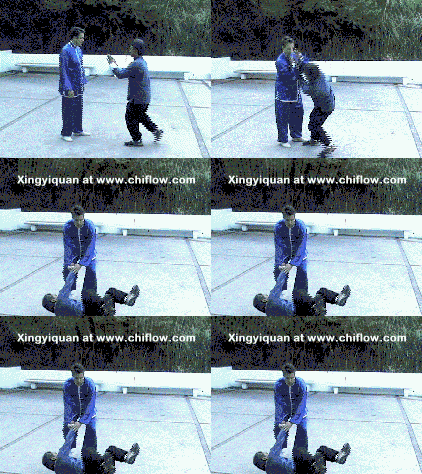
San Cai (Three Bodies) form - (ward off)
This is an example application of the beginning form of Hsing-I Chuan (Xingyiquan) known as San Cai (or San Ti) Shi (The Three Bodies form). In this instance, the opponent's elbows are exposed as he attempts a lapel grab, and therefore his attack is more simply neutralized with the least amount of force. There are a variety of ways to handle any attack situation. It is possible in this scenario to lift the elbows and shoot to do a single or double leg takedown. However, one simple approach is to bring the defender's arms around the attackers arms, pinning the elbows, and thereby exposing the opponent's center of gravity.
The beginning form of Xingyiquan, or San Cai Shi, has a variety of applications and usages. It is the T’ai Chi of Hsing-I or Yin Yang posture that is formed from the Void. Supposedly, from this one, seemingly, simple form the entire contents of Hsing-I Chuan can be practiced and realized. This style of Hsing-I Ch'uan is organized using 12 Animals that group and teach the martial characteristics of particular actions. On a fundamental level, Hsing I is built on "Five Elements" (or "Five Phases") that provide a system for categorizing and understanding the relationships between 5 types of dynamics.
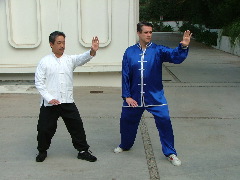 The Three Bodies have an inner and an outer application. The inner refers to three combinations as follows: the mind and the will, the will and the chi, and the chi and stamina. The three outer combinations are the hands with the feet, the elbows with the knees, and the shoulders with the hips. This not a reference to moving these combinations in tandem necessarily, but most definitely involves alignment and the sequentiality of movement. The alignment is often learned by standing in the San Cai posture in meditation with the left hand pushed out (yang) at chest level and the right hand pushed down (yin) to the lower abdomen with the thumb pointing up at the navel. The root of the index finger on the upper hand is lined up with the nose and the front foot. The torso is upright, yet at ease, and not leaning in either direction. Physically, in the beginning stages, sixty percent of the weight is on the rear right leg, while 40 percent is on the front leg. In the advanced stage, the weight distribution involves using the mind to discover yang within yin and yin within yang, or substantiality within insubstantiality and vice-a-versa. Hold the head up, yet relax the neck and tuck the chin. Relax the face and do not clench the teeth or lift the chin. The shoulders ought to relax, the palms are slightly concaved, release the chest, suspend the tailbone as if sitting down, relax the knees, the ankles (especially), and sink through the Yongquan (or, "Running Spring") point on the rearfoot. The Yongquan is located in the center, behind the ball of the foot.
As a prelude for moving into the Three Bodies posture, move the hands first, follow with the body, and trail with the feet. Once in the posture, relax the hands but keep the concavity, release any upward tension in the body but maintain erectness, stand still on the foot (pillaring) while sinking (staking) the rear. Over and over, from up to down search out and release all tension and stress. Using "centers" can help you discover buoyancy and inner strength. Of prime consideration is the utilization of "centers." These "centers." I am referring to are, for example (but certainly not limited to): the elbows for the upper limbs, the rhomboids between the scapulae for the upper torso, the lower dantian for the hips (and the vertical aspect), the knees for the lower limbs; even the intermediate phalanges for each of the metacarpals. Using these "centers" and others you discover while standing, to release any tension you may encounter, can help heal discomfort, as well as develop internal power.
Concerning the stance, some practitioners draw the knees together towards each other, while others open the groin and knees to ensure suspension of the tailbone. Regardless one is not better than another. The main point is that the hands, body, and feet work together sequentially, and yet as one unit. In meditation, this sequence successfully moves chi away from the head and upper torso, and in application the hands follow each other like multiple leaves and branches (hands and arms) followed by a strong stem (the body) and supported with "prop-like" roots (the feet).
See either the "Hsing I Ch'uan Overview" or the "Introduction to Xingyiquan" pages by clicking on the "Hsing I" button.
Click here to go to the Introduction to Xingyiquan page.
Click here to go to the Overview of Hsing I Ch'uan page.
www.Chiflow.com offers various materials, including books and videos, at our linked store site. We offer some excellent Classic Books on Hsing I Chuan that can be hard to find in English: