


Baguazhang and Pa Kua Chang are different English translation schemes for the same Eight Trigrams Palm martial art. It is linked to the teachings of Tung Hai Chuan (Dong Hai Quan, 1797-1882 A.D.). Pa Kua Chang is often associated with Taoist practices including circle walking.
Overview of Pa Kua Chang (Ba Gua Zhang)-Part 2
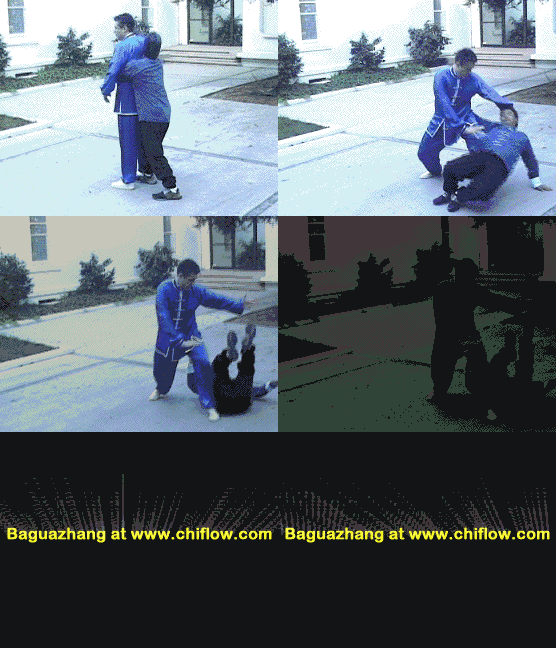
(Left) An animated picture of an application of Pa Kua Chang (Baguazhang) "White Snake Coils its Body (right)" transitioning to "Embrace the Moon to the Center of the Breast (left)". This application is from the Jiang Rong Qiao system of Nei Jia Kung fu, which includes Xingyiquan, Baguazhang and a version of Taijiquan
By Gerald A. Sharp and Chi Flow Webmaster Dave
Eight Trigrams Palm
There are examples of martial applications of Pakua Chang (Bagua Zhang) elsewhere on this site. There is a collection of example applications for the set of eight Mother Palms. There are examples of the different Nei Jia kung fu styles that can be used for comparison.
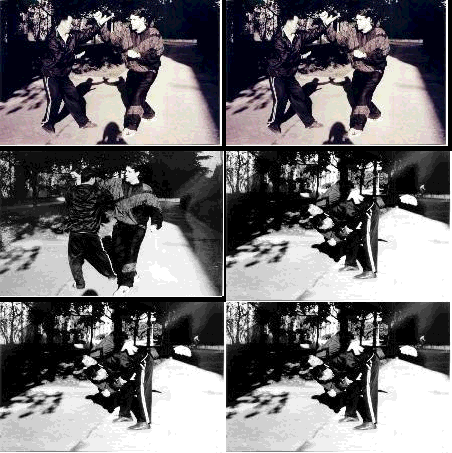
Remove the Helmet From Behind the Head (Chen Jie Feng and Gerald A. Sharp)
|
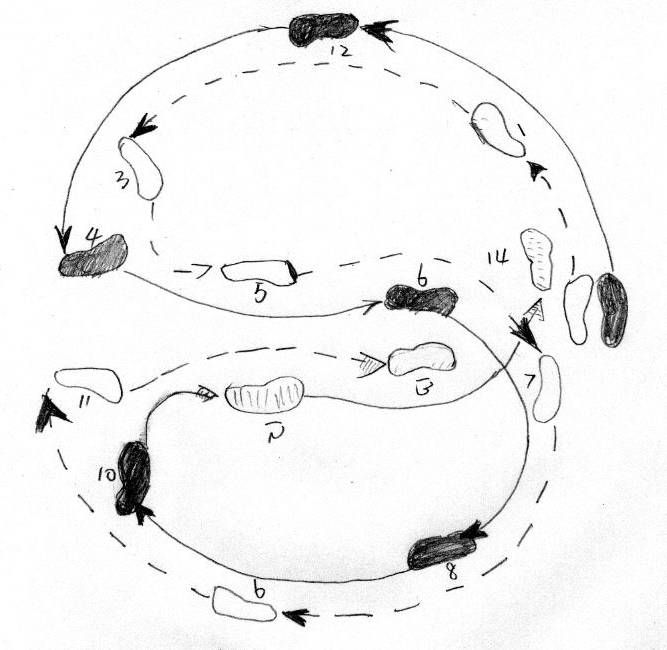
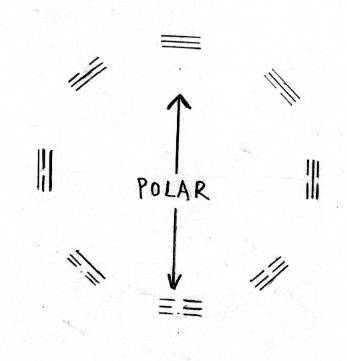
1.The Systemization of Ba Gua Zhang The Systemization of Ba Gua Zhang can be viewed as dividing up or joining together the possibilities of the movements by type using the trigrams, then selecting the response using either the Pre-Heaven (polar) or Post-Heaven (cyclic) arrangement. The progressive nature of the symbols lead to a never ending array of possibilities. The Pre-Heaven, or Polar arrangement, symbol of Bagua is the foundation, or nucleus of Baguazhang theory and practice. The Pre-Heaven is basically associated with opposites which are identified philosophically as:
Therefore the practitioner of Bagua varies the way they attack up and down, left and right, front and back, inside and outside. The hands and feet are trained to protect the body, and move in a wave by following the natural formula of hand, body, and foot. Without the ability to correctly employ the palms and the steps together, the odds are very much against an application of Baguazhang having any effect against an experienced opponent. With the correct application of the steps, integrated body structure, and intuitive understanding of the palms changes, Baguazhang is efficient and formidible.
|
2. Cycles, Circles and the Process of Change
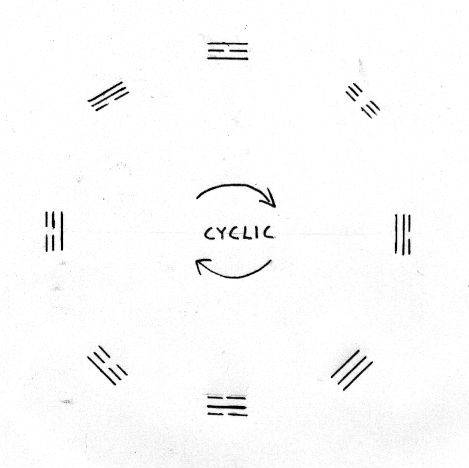
The Post-Heaven symbol is said to be derived from natural cyclic changes of the seasons. This is thought to primarily focus on Bagua's circle and circling movements. The Post-Heaven symbol also is a template to explain the cyclic process of elements, such as Water, for example, when it changes from a solid to a liquid, a liquid to a vapor, and from a vapor to a liquid only to become a solid again and again depending on the seasons or atmospheric conditions. The practitioner ought to emulate the process of change observed in natural phenomena in their practice: change needs to occur both inside your body and in the outside shape. Much of the time these changes are small, but during the transitions the changes can be large. |
|
3. A Binary Perspective It may be that the above traditional presentation of the Pa Kua Trigrams is the only valid way to consider the approach of Pa Kua Chang. It may be that the ancient people who invented the zero and much of the foundation of mathematics had a complete lapse in developing one of the central philosophical aspects of their society. Alternatively, it may be that a translation of the these touchstones into a more familar mathematical context can make the entire discussion less obsure We can immediately associate the trigrams of Pa Kua with binary numbers from 7 to 0 (read the trigrams from the bottom up). The Polar transformation of the Pre-Heaven Trigram is accomplished by transposing the 1's and 0's to get an inverse.
The Post-Heaven cycle is a way of covering the permutations, but the order is: 111 (7) to 010 (2) to 001 (1) to 100 (4) to 011 (3) to 101 (5) to 000 (0) to 110 (6) and back to 111 (7). |
4. All the Angles on the Circle Bagua doesn’t rely on speed in application, and instead focuses on staying connected to the center, or spine, of their opponent, while at the same time concealing their own central equilibrium. Having command of the Pre- and Post-Heaven strategies evokes the possibility to employ a barrage of strategies aimed at both dismantling opposing threat and concealing the intentions of the practitioner with behaviors such as feinting right to move left, and cyclic qualities such as changing the angle, or eradicating the center line, to gain advantage of the back, or “dead angle” of an opponent. When the possibilities of the polar and cyclical aspects of Bagua are joined together, and internalized by the practitioner, combined with strong roots for ultimate stability, the practitioner is then able to more subtly turn and twist not only to have flexibility as a martial artist but to potentially derive greater subtlety from the practice. In this way, they can begin to go more in-depth in focusing on the application of the art.
|
|
5. Integrated Structure and Movement in Application To effectively apply Pa Kua Chang, the practitioner is advised to embrace the changes of the situation and the intentions of the opponent, and not go into a joint-hands or sparring situation with a predetermined set of actions. Instead, trust the practice, the development of the human instrument, and use whatever the opponent presents as "the way." Focus on accepting what is front of you instead of expecting things to be anything other than what they are. Learn to relax when attacked, and focus on what the opponent brings. In this way, Pa Kua Chang emerges as one of the most interesting of internal or external martial arts. The period for growth and contemplation increases with practice and the limits of the over the course of time. Constantly embracing any and all changes that are presented with each and every moment.
|
6. The Footwork of Ba Gua Zhang (For a more complete article on Bagua's stepping methods was published in Qi Journal, Volume 16, No. 1, Spring 2006)
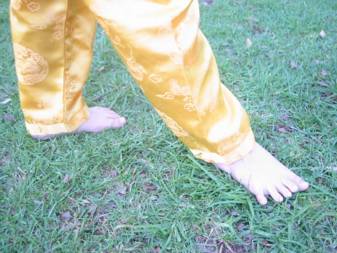
One of the aspects of Baguazhang that makes it so versatile with respect to the choice of hand movements is the footwork. The footwork of Baguazhang is perhaps the most diverse of any martial art. Baguazhang exploits the footwork in a number of ways. First of all, while it is not the only step in Baguazhang’s arsenal, the Tang Ne Bu (or, “Sliding in the Mud Step”) is one of the main stepping methods. In Jiang Rong Qiao’s classic text, Baguazhang Liangxi Fa (Eight Diagrams Palms Practice Method), he describes Bagua’s step as follows: “Bend the legs, treading the mud step; the centers of the feet are hollow.” This “Sliding in the Mud Step” is not done with force or by pressing deeply with each and every step. Instead, the step is more practical and useful when the foot falls levelly with the surface and the toes grasp the ground. Moreover, the feet should rise only slightly, if at all, and step down gently without exposing the heel or the sole of the foot more than a finger’s height. This is why this step is also sometimes referred to as the “Snake Step”, especially when the feet are advanced with little or no lifting. Instead of any force being utilized in the feet to advance, it is a sinking action in the hips that pushes the legs, knees, and feet forward like coils. To fulfill such painstaking details, it is most important then for the ankles and feet to relax. |
|
7. Other Steps Another popular method for training leg strength and flexibility in the legs and feet is the “Crane Step.” In this method, the leg is purposely raised up at the knee, and dropped down evenly and squarely like a crane would walk in the shallow end of the lake. Again the rule of hollowing the foot is adhered to in this method as well. Yet another method, which is used in Jiang Rong Qiao’s Old Eight Palms practice, is the “Chicken Step.” Often thought to be strictly used only in Xingyiquan practice, the Chicken Step is used in the fifth palm of Jiang’s Old Eight Palms more specifically, and allows for the same training of rooting and flexible, low kicking shin kicks and stomps similar to Xingyiquan’s Chicken Step method. Knowledge of Bagua’s stepping methods, train the ankle to relax and increase knowledge of how to use the feet to support, strengthen the hands and thereby develop, harness, and utilize internal, sophisticated power. |
8. Related Links and Martial Applications The chiflow.com web site has a growing set of martial art application examples. Check out these related pages featuring applications and further information on Baguazhang, Nei Jia Kung Fu, and Xingyiquan:
Go to Chiflow.com home page |
 About Us | Site Map | Privacy Policy | Contact Us | all content and images ©2008 Gerald A. Sharp and Chiflow.com